Only God Forgives (2013)
The tension in this movie is what really stays with you even after it ends.
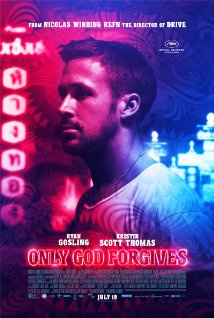
Only God Forgives (2013) will remind many viewers of Drive (2011), and some of Valhalla Rising (2009). All three are directed by Nicolas Winding Refn and you can definitely see his signature style in all these films. I personally really like his work, but reviews are mixed for this particular film. This is no surprise because the film is not the typical Hollywood blockbuster, so many people are likely to watch it with different expectations.
Fans of movies made by Gaspar Noé will appreciate this movie. in fact, Noé visited the film set and he's being thanked in the credits. Nicolas Winding Refn was clearly inspired by Noé's work. In addition, he dedicated the film to Alejandro Jodorowsky, whose work has always beeb ahead of his time and deeper in meaning than many his fellow directors, writers and producers. The point of this whole movie trivia bit is to show the kind of movie this is, to give it a bit of lineage if I can call it that. It's not your typical date night movie by a long shot.
Out of the three, Only God Forgives seems to get the worst reputation. However, I really liked this movie and I believe it has a meditative quality, not in the sense that it relaxes you, but in the sense that you can watch it more than once and each time you can try to see deeper into the details. There are a few elements that stand out when I watch this movie: the unknown history of the characters, the silence, and the tension.
Who are These People?
The movie begins with a murder and we realize quickly that Ryan Gosling's character, Julian, and his brother Billy are criminals, using a Thai boxing club as a front while their real business is illegal. We never get too much detail of the real business other than it has to do with drug smuggling. We get the sense that Julian is an unwilling criminal, that he does not really love the life of crime. There's a sense of reluctance to what he does.
On the other side of the rink we have the local police force and Chang. I don't want to call Chang the “hero” of the film because his methods are questionable, but he's the closest thing we have to one. His aim is to restore order, and he's successful. All this sounds very generic, and as you can see there is not too much detail given. The viewer has to use the power of imagination to fill in the gaps or infer meaning. For example, Chang does not wear a uniform, and yet the other officers respect him implicitly. Is he retired? Is he not really a police officer? How come he carries a sword? He's a frightening figure to all that cross him and the sense of unknown and mystery surrounding Chang makes him even more impressive. Consequently, we get this tremendous contrast between the imposing figure of Chang who calmly restores order without mercy, and Julian, who is not a very good criminal and who can only evoke pity in the viewer.
Silent but Deadly
There isn't much dialogue in Only God Forgives. That's why we learn little about the back story or the characters aside from what we witness on screen through their actions. The silence is especially effective juxtaposed with the musical sequences. While Chang does not speak much, he does sing! There are two scenes where he is singing in a restaurant to an enthralled audience. This gives Chang a very human trait and it contrasts greatly with his violent methods. It's so interesting seeing this mysterious agent dish out justice with his sword one moment, and singing a ballad the next.
Julian is pretty quiet too, but in his case I took the silence to signify more of an inability to assert himself or to make a stand. He seems to patiently accept what others tell him and when he does reach his limit, he takes it out on the wrong people. And yet, I can't help but feel a little bad for him. When it's time for specific decisions, he shows mercy, twice, in spite of his criminal duties.
Overall, the silence allows the viewers to take in the beautiful visual style of the movie. Neon lights and the backdrop of Bangkok, interesting angles and scenes, intense close ups that let you sense what the characters are thinking and feeling. You just have to experience the movie rather than simply watch it to see what happens at the end.
I Can Feel it Coming in the Air Tonight
The tension in this movie is what really stays with you even after it ends. The tension is tangible, partly due to the minimal dialogue, and partly due to the foreshadowing that keeps popping up in various scenes. The combination creates a sense of foreboding. You just feel something bad is about to happen. Everyone on the screen is on the edge, especially the criminals, but less so Chang. In fact, Chang's calm sense of control is like an anchor amidst all the tension. You just know that nothing can stop Chang: he is a force of nature; not a wild tornado, but more of a slow steady snowfall that will eventually bury everyone. All they can do is pray for mercy, but as the movie title tells us, only God forgives.
Thank you for reading! #review
©️ Razvan Ungureanu